

A name is the first spell a character casts. The right succubus name tells readers who she is before she speaks. It hints at charm, danger, and a past she would rather not discuss.
Whether you are writing a dark fantasy novel, building a D&D character, or naming an anime-style demon, the search starts here. This guide covers succubus names and meanings, from classic female demon names to incubus names, cute picks, and wicked ones. Every entry includes its origin or a short descriptive detail.
Browse by mood, steal a favorite, or mix your own using the generator. You will find mythological figures, gothic names, RPG-ready titles, and Japanese-inspired options. Pick the one that feels like it was whispered to you at midnight.
More Names You Might Love: Doctor Names
Succubus Names Generator
Discover seductive, dark, mysterious, and mythical succubus names for fantasy characters, stories, games, and creative projects.
Ideal for fantasy characters, RPGs, novels, games, usernames, mythology-inspired stories, and creative writing.
Succubus Origins and Mythology
The succubus is a female demon in medieval Christian folklore. She was said to visit sleeping men at night and drain their vitality. The word comes from the Latin succubare, “to lie beneath.” Her male counterpart, the incubus, comes from incubare, “to lie upon.”
The idea is much older than the word. Ancient Mesopotamia, Greece, and Jewish folklore all told of night-prowling female spirits. Medieval scholars blended these tales into the succubus we know today. Modern fiction, games, and anime then reshaped her into a complex figure who is sometimes villain, sometimes antihero, sometimes ally.
Knowing these roots helps you choose a name with real depth. These mythological figures are the ancestors of the modern succubus:
- Lilith: Hebrew folklore’s first demoness, linked to the word for “night”
- Lilitu: Mesopotamian storm and wind demon, an early model for night spirits
- Ardat Lili: Akkadian “maiden of Lilitu,” a night spirit who visited men
- Lamashtu: Mesopotamian demoness feared for threatening mothers and infants
- Naamah: Kabbalistic demoness said to seduce men in their sleep
- Agrat bat Mahlat: Talmudic queen of demons who roamed at night
- Eisheth Zenunim: Kabbalistic demon whose name means “woman of harlotry”
- Lamia: Greek queen cursed into a monstrous, child-devouring seductress
- Empusa: Greek shape-shifting specter who lured travelers
- Mormo: Greek bogeywoman used to frighten children into behaving
- Gello: Greek spirit blamed for untimely deaths
- Striga: Roman and Balkan night-witch, often pictured as a bird
- Mara: Slavic and Germanic nightmare spirit that sat on sleepers’ chests
- Alp: Germanic nightmare elf, a close cousin of the incubus legend
- Jorogumo: Japanese spider yokai who takes the form of a beautiful woman
- Huli Jing: Chinese fox spirit that charms humans in disguise
Female Succubus Names
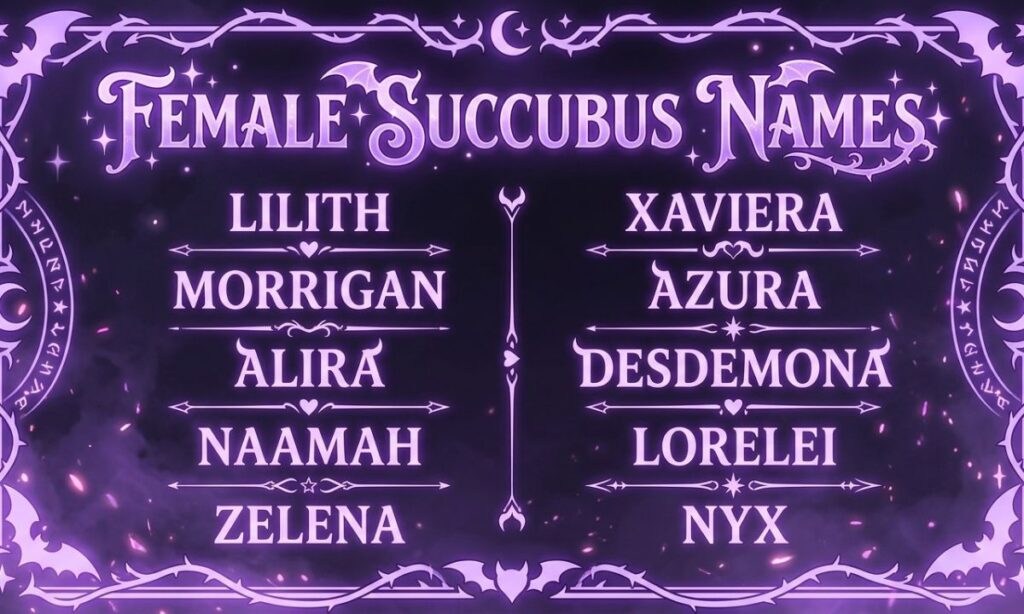
Female succubus names are the heart of this list. They blend ancient goddesses, gothic heroines, and dark gemstone imagery. Each one below suits a classic succubus, whether she lives in a novel, a game, or a roleplay.
- Lilith: Hebrew “night”; the archetypal dark seductress
- Nyx: Greek goddess of night
- Selene: Greek moon goddess, silver and mysterious
- Hecate: Greek goddess of witchcraft and crossroads
- Circe: Greek enchantress who bewitched sailors
- Morgana: Arthurian sorceress; often linked to Welsh “sea-born”
- Delilah: Hebrew, often read as “delicate”; Samson’s betrayer
- Jezebel: Biblical queen whose name became shorthand for temptress
- Salome: Hebrew “peace”; the dancer of the Gospel tale
- Belladonna: Italian “beautiful lady”; also deadly nightshade
- Vesper: Latin “evening”
- Seraphine: From Hebrew seraph, “fiery one”
- Lucinda: Latin “light”; ironic for a creature of shadow
- Mirabel: Latin “wonderful”
- Scarlett: Old French for scarlet cloth; passion and sin
- Crimson: Deep red, the color of blood and desire
- Raven: Dark-feathered bird of omens
- Ebony: Dark, polished wood
- Onyx: Greek “claw”; black gemstone
- Valentina: Latin “strong, healthy”
- Carmilla: Heroine of Le Fanu’s gothic novella
- Morwenna: Cornish “maiden”
- Isolde: Tragic lover of Arthurian legend
- Evangeline: Greek “good news”; a sweet name with a sly edge
- Lenore: Poe’s lost, haunting lady
- Ligeia: Greek “clear-voiced,” the name of a siren
- Persephone: Greek queen of the underworld
- Pandora: Greek “all-gifted”; opener of troubles
- Cassandra: Greek prophetess nobody believed
- Ravenna: Italian city name that echoes “raven”
- Zephyra: Coined from zephyr, the gentle west wind
- Azura: Spanish and Persian “sky blue”
- Morrigan: Irish goddess of war and fate
- Lorelei: German Rhine rock siren who lured sailors
- Medusa: Greek “guardian”; the gorgon with a deadly gaze
- Sirena: Italian and Spanish “siren”
- Rhiannon: Welsh “great queen”
- Arachne: Greek “spider”; the weaver cursed by a goddess
- Bellatrix: Latin “female warrior”; also a star
- Drusilla: Roman family name meaning “strong”
- Kalista: Greek “most beautiful”
- Vivienne: Latin “alive”
- Estella: Latin “star”
- Aurelia: Latin “golden”
- Magdalena: Hebrew “of Magdala”
- Cordelia: Latin-rooted “heart”; Shakespearean daughter
- Octavia: Latin “eighth”; imperial and elegant
- Ophelia: Greek “help”; tragic and poetic
- Tempest: English “storm”
- Velvet: Soft, luxurious fabric
- Sable: Black fur, associated with luxury
- Morticia: Built on Latin mors, “death”; gothic icon
- Nocturna: Latin “of the night”
- Lysandra: Greek “liberator”
- Vanora: Welsh variant of Guinevere, “white wave”
Male Succubus Names (Incubus)
Technically, a male succubus is an incubus. These incubus names borrow from fallen angels, tragic heroes, and charming rogues. They work for dark romance, tabletop campaigns, and fantasy fiction.
- Asmodeus: Demon king of lust, rooted in Persian Aeshma Daeva
- Lucian: Latin “light”
- Lucifer: Latin “light-bringer”; the fallen angel
- Damien: Greek “to tame”
- Dorian: Greek “of Doris”; Wilde’s beautiful, corrupted Gray
- Vlad: Slavic “ruler”
- Alaric: Gothic “ruler of all”
- Lysander: Greek “liberator”
- Cassius: Latin “hollow”; Roman family name
- Dante: Latin “enduring”; poet of the Inferno
- Mephisto: Short for Mephistopheles, the devil of the Faust legend
- Belial: Hebrew “worthless”
- Azazel: Hebrew, a desert demon tied to the scapegoat ritual
- Malachai: Hebrew “my messenger”
- Lazarus: Hebrew “God helps”; the man raised from death
- Sebastian: Greek “venerable”
- Dominic: Latin “of the Lord”
- Julian: From the Roman name Julius
- Adrian: Latin “from Hadria”
- Cain: Hebrew “acquired”; first murderer
- Draven: Modern name popularized by The Crow
- Evander: Greek “good man”
- Kieran: Irish “little dark one”
- Ronan: Irish “little seal”
- Lorcan: Irish “little fierce one”
- Caelum: Latin “sky”
- Morpheus: Greek god of dreams
- Hypnos: Greek personification of sleep
- Eros: Greek god of love
- Dionysus: Greek god of wine and ecstasy
- Pan: Greek “all”; wild god of the woods
- Loki: Norse trickster
- Baal: Semitic “lord”
- Zagan: Demon of the Ars Goetia
- Paimon: Goetic king of obedient spirits
- Vassago: Goetic prince, said to reveal secrets
- Marchosias: Goetic marquis with a wolf form
- Valefar: Goetic duke tied to cunning and theft
- Raziel: Hebrew “secret of God”
- Silas: Latin “forest”
- Ezekiel: Hebrew “God strengthens”
- Thane: Old English “retainer”; a noble warrior
- Crispin: Latin “curly-haired”
- Gideon: Hebrew “feller of trees”
- Tristan: Celtic, linked to “tumult”; doomed lover
- Lancelot: Arthurian knight of forbidden love
- Orpheus: Greek musician who charmed the dead
- Narcissus: Greek youth undone by his own reflection
- Adonis: Greek symbol of male beauty
- Ambrose: Greek “immortal”
- Valerian: Latin “strong”
- Cyrus: Persian “sun”
- Alastair: Greek-derived “defender”
- Maddox: Welsh “fortunate”
- Soren: Danish “stern”
Seductive Succubus Names
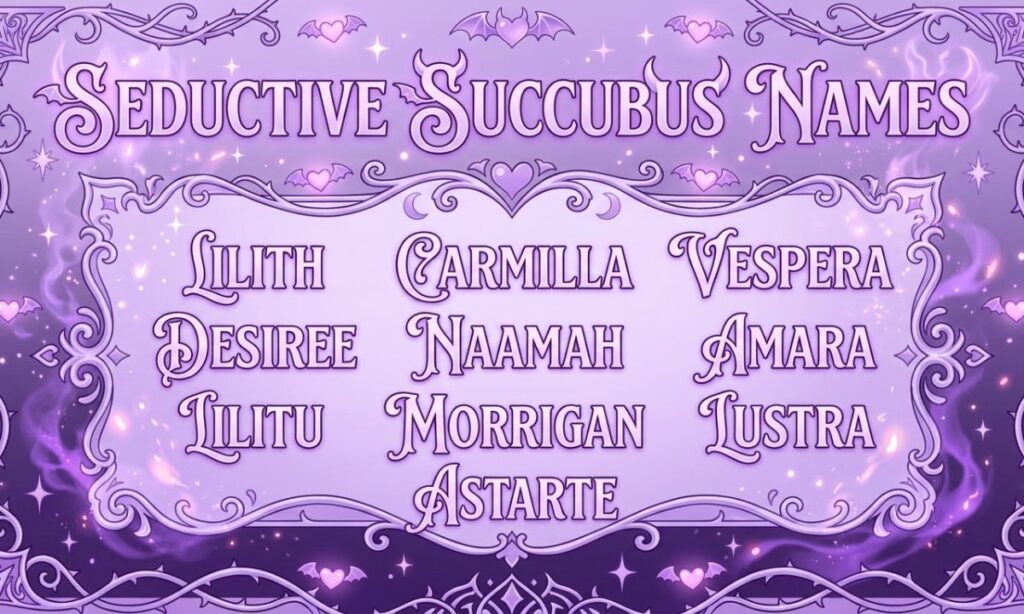
Seductive names should feel like perfume and candlelight. They lean on goddesses of love, legendary charmers, and soft, flowing sounds. Use them for the succubus who wins with a smile, not a sword.
- Allura: Coined from “allure”
- Desirée: French “desire”
- Venus: Roman goddess of love
- Aphrodite: Greek goddess of love and beauty
- Freya: Norse goddess of love and magic
- Ishtar: Mesopotamian goddess of love and war
- Astarte: Phoenician goddess of love and fertility
- Inanna: Sumerian queen of heaven
- Cleopatra: Greek “glory of the father”; Egypt’s legendary queen
- Messalina: Roman empress of scandalous reputation
- Roxana: Persian “dawn”
- Layla: Arabic “night”
- Sapphira: Greek “sapphire”
- Amara: Igbo “grace”; Latin “bitter”
- Esmeralda: Spanish “emerald”
- Dahlia: Flower named after botanist Anders Dahl
- Rouge: French “red”
- Satine: From French satin, smooth and sleek
- Mirage: A shimmering illusion
- Cherie: French “dear”
- Coquette: French “flirt”
- Bijou: French “jewel”
- Sultana: Arabic “queen”
- Zahara: Arabic “blooming, radiant”
- Jasmine: Persian “gift from God”; fragrant night bloom
- Scheherazade: Persian storyteller who enchanted a king
- Mata Hari: Malay “eye of the day”; the spy-dancer’s stage name
- Lola: Spanish diminutive of Dolores, “sorrows”
- Maeve: Irish “intoxicating”
- Isabeau: Old French form of Isabel
- Vixen: A cunning female fox
- Velora: Coined, a silken, velvet-sounding name
- Noirette: Coined from French noir, “black”
- Sorcha: Irish “radiance”
- Lilou: French pet name, playful and soft
- Giselle: Germanic “pledge”
- Colette: French “victory of the people”
- Fleur: French “flower”
- Odalisque: From Turkish odalik, “chambermaid”; a classic harem-art muse
- Gilda: Old English “golden”
- Rosalie: Latin “rose garden”
- Kismet: Arabic “fate”
- Rhapsody: Greek-rooted “ecstatic song”
- Divina: Latin “divine”
- Delphine: Greek, linked to Delphi and “dolphin”
- Charis: Greek “grace”
- Tamsin: Cornish form of Thomasina, “twin”
- Bordeaux: French wine region; rich and red
- Séance: French “sitting”; a summoning ritual
- Nocturne: A dreamy musical piece for the night
Cute Succubus Names
Not every succubus is menacing. A cute demon girl can be playful, mischievous, and a little clumsy. These names suit chibi characters, comedic fantasy, and lighthearted roleplay.
- Poppy: Bright flower name, sweet and cheerful
- Bonbon: French “candy”
- Pixie: Tiny, mischievous fairy
- Lulu: Playful short name, often from Louise
- Mimi: Affectionate and bubbly
- Cinnamon: Warm spice, cozy and sweet
- Pumpkin: A classic pet name
- Cupcake: Sweet treat with a frosting-pink vibe
- Sprinkle: Colorful and tiny
- Imp: A small, naughty demon
- Fizz: Bubbly and energetic
- Pippa: Greek “lover of horses”
- Mochi: Japanese rice cake; soft and chewy
- Boo: A cute little scare
- Pudding: Soft, sweet, and wobbly
- Peachy: Fruity and warm
- Sugarplum: Fairy-tale candy
- Honeybun: Sweet and golden
- Clover: Lucky, lighthearted
- Wisp: A tiny puff of smoke or spirit
- Twinkle: Sparkly and bright
- Biscuit: Warm and comforting
- Marshmallow: Soft, fluffy, sweet
- Tilly: Short for Matilda, “mighty in battle”
- Fawn: A young deer; shy and gentle
- Pebble: Small and smooth
- Juju: Playful, with a hint of magic
- Coco: Warm, chic, and tropical
- Lottie: Diminutive of Charlotte, “free woman”
- Minnie: Tiny and sweet
- Posy: A small bouquet
- Tansy: Yellow herb flower
- Snowdrop: Early spring flower
- Pip: Small seed or spark
- Fable: A story with a moral and a wink
- Trixie: Mischievous, from Beatrix
- Jinx: A playful bit of bad luck
- Dewdrop: Morning freshness
- Ladybug: Small, red, and charming
- Sorbet: Cool, fruity, and light
- Truffle: Rich chocolate treat
- Plum: Round and sweet
- Cricket: Small night singer
- Moxie: Spunky courage
- Tulip: Cheerful spring bloom
- Nutmeg: Warm, spicy, and sweet
Evil Succubus Names
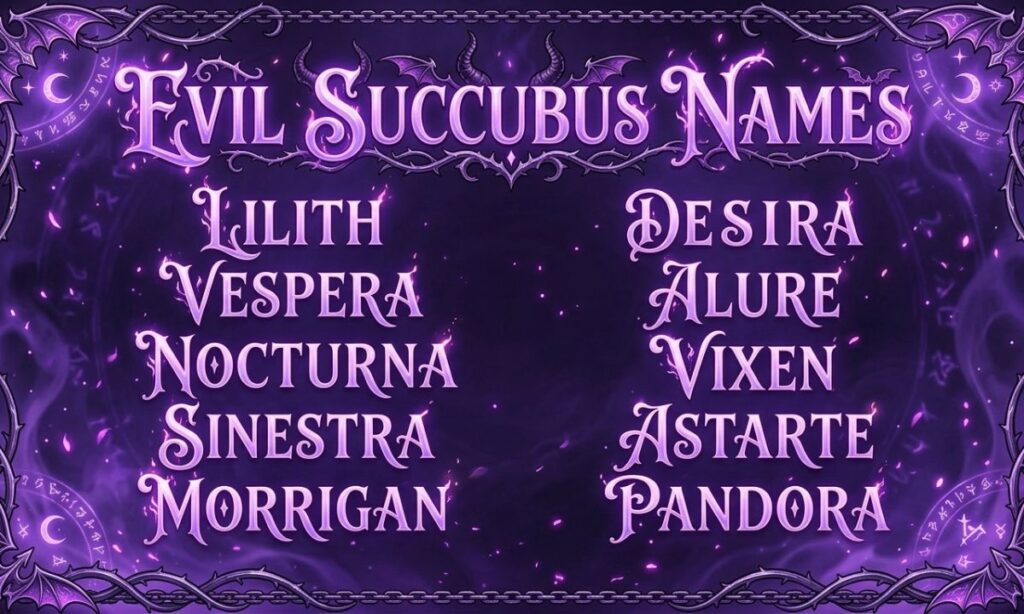
Evil succubus names should sound like a threat wrapped in silk. These draw on Greek furies, Latin curses, and the seven deadly sins. They suit villains, cursed bargains, and nightmares.
- Hel: Norse ruler of the realm of the dead
- Nemesis: Greek goddess of retribution
- Eris: Greek goddess of strife
- Tisiphone: Greek Fury, “avenger of murder”
- Megaera: Greek Fury, “jealous”
- Alecto: Greek Fury, “unceasing”
- Ate: Greek spirit of ruin and folly
- Sinistra: Latin “left”; ominous and unlucky
- Maledicta: Latin “cursed”
- Venefica: Latin “poisoner”
- Noxia: Latin “harm”
- Morgause: Arthurian sorceress queen
- Grimalkin: Old English name for a witch’s cat
- Maleficia: Latin “wrongdoing”
- Perdita: Latin “lost”
- Invidia: Latin “envy”
- Superbia: Latin “pride”
- Ira: Latin “wrath”
- Avaritia: Latin “greed”
- Luxuria: Latin “lust”
- Gula: Latin “gluttony”
- Vanitas: Latin “emptiness”; symbol of fleeting life
- Acedia: Greek-rooted “sloth” or spiritual apathy
- Mammon: Aramaic “wealth”; demon of greed
- Leviathan: Hebrew sea monster; a demon of envy in later lore
- Beelzebub: “Lord of the Flies”
- Abaddon: Hebrew “destruction”
- Malphas: Goetic demon of builders and deceit
- Moloch: Ancient fire deity linked to sacrifice
- Baphomet: Occult goat-headed symbol
- Belphegor: Demon of sloth and clever invention
- Vexa: Coined from “vex”
- Hexana: Coined from “hex”
- Dreadella: Coined from “dread”
- Mordreth: Coined from Latin mors, “death”
- Nefaria: Latin “wicked”
- Furia: Latin “fury”
- Tenebra: Latin “darkness”
- Caliga: Latin “mist, gloom”
- Lethe: River of forgetfulness in Greek myth
- Thanatia: Coined from Greek Thanatos, “death”
- Pestilia: Coined from “pestilence”
- Rancora: Coined from “rancor”
- Vendetta: Italian “blood feud”
- Bane: Old English “killer”
- Dirge: A funeral song
- Strix: Latin owl-witch of Roman legend
- Nightshade: A poisonous plant of the dark
- Hemlock: A deadly plant, famed from Socrates’ death
- Wormwood: A bitter herb, and the name of a Biblical star of doom
More Names You Might Love: Christian Usernames
Good Succubus Names
Some succubi break their curse or reject their nature. A good succubus can be a redeemed heroine, a guardian, or a gentle soul fighting her own origin. These names signal hope and light.
- Aurora: Latin “dawn”
- Celeste: Latin “heavenly”
- Seraphiel: Coined from seraph and -el, “angel of God”
- Solace: Comfort in sorrow
- Grace: Latin gratia, “favor”
- Mercy: Compassion shown to the undeserving
- Hope: Belief in a better tomorrow
- Faith: Trust beyond sight
- Serenity: Calm of mind
- Halo: Ring of light
- Lumina: From Latin lumen, “light”
- Ariel: Hebrew “lion of God”
- Eirene: Greek “peace”
- Amity: Friendship and goodwill
- Clementine: Latin “merciful”
- Felicity: Latin “happiness”
- Beatrix: Latin “she who brings happiness”
- Gabriella: Hebrew “God is my strength”
- Selah: Hebrew pause in the Psalms
- Noor: Arabic “light”
- Astraea: Greek “star maiden”; goddess of justice
- Elara: Mythic lover of Zeus; a moon of Jupiter
- Calliope: Greek “beautiful voice”; muse of epic poetry
- Thalia: Greek “blooming”
- Zora: Slavic “dawn”
- Alba: Latin “white”; also “dawn”
- Verity: Latin “truth”
- Sage: Herb and symbol of wisdom
- Liora: Hebrew “light is mine”
- Anwen: Welsh “very fair”
- Elowen: Cornish “elm”
- Phoebe: Greek “bright”
- Marigold: Golden flower, linked to the Virgin Mary
- Solenne: French “solemn”; dignified and calm
- Honora: Latin “honor”
- Aislin: Irish “dream” or “vision”
- Bliss: Perfect joy
- Cadence: Latin “rhythm”; the fall of music
- Harmony: Greek “agreement, concord”
- Joy: Delight, plain and pure
Unique Succubus Names
Want a name nobody else has used? These coined and rare picks are built from Latin, Greek, and Old English roots. Each one sounds mythic without copying a famous character.
- Zyraelle: Blend of “zephyr” and Rael; a silken storm
- Nyxara: Nyx plus -ara; night-born
- Vexilia: From “vex”; teasing menace
- Lilureth: Lilith plus “lure”
- Oblivia: From “oblivion”
- Sylvaine: From Latin silva, “forest”
- Mortessa: From Latin mors, “death,” with an elegant ending
- Xanthe: Greek “golden”
- Thessaly: Greek region famed for witches
- Nerezza: From Italian nero, “black”
- Umbrielle: From Latin umbra, “shadow”
- Emberine: From “ember”; a slow-burning glow
- Dusklyn: From “dusk”
- Veyra: Coined from “veil”
- Morwyn: Mor (“sea”) plus wyn (“fair”)
- Seraphyx: Seraph with a sharper edge
- Ashenne: From “ash”
- Noctyra: From Latin nox, noctis, “night”
- Vespera: Feminine Latin “evening”
- Lumeria: From lumen, with a shadowy twist
- Kyrazel: Coined, sharp and exotic
- Orchidea: Italian “orchid”; exotic and delicate
- Wraithe: From “wraith”
- Lysara: Coined from Greek lysis, “release”
- Calixta: Greek “most beautiful”
- Zinnia: Flower named after Johann Zinn
- Azrielle: Blend of Azrael and a French ending
- Cindra: From “cinder”
- Eclipsa: From “eclipse”
- Maribel: Latin-based “beautiful sea”
- Thaumara: From Greek thauma, “wonder”
- Phantasia: Greek “imagination”
- Nerissa: Greek “sea nymph”
- Rosamund: Germanic “horse protection”; often read as “rose of the world”
- Odile: Black swan of Swan Lake
- Zenaida: Greek “of Zeus”
- Sepulcra: From “sepulcher,” a tomb
- Amaranthe: Greek “unfading flower”
- Galaxia: Greek “milky”; a star-sprinkled name
- Lucerna: Latin “lamp”
- Verbena: Latin plant name tied to charms
- Ilvara: Coined, airy and cold
- Obsidia: From obsidian, black volcanic glass
- Pyrelle: From Greek pyr, “fire”
- Rubyra: Coined from “ruby”
- Glacia: From Latin glacies, “ice”
- Marisela: Latin “sea” with a Spanish sparkle
- Tenebria: From Latin tenebrae, “darkness”
- Withera: From “wither”
- Zodiaca: From “zodiac,” the star-bound wheel
D&D and RPG Succubus Names
Tabletop and video game succubi need names that fit on a character sheet and sound right at the table. The first three below are real names from gaming lore. The rest are original, built for campaigns, NPCs, and boss encounters.
- Malcanthet: D&D’s Demon Queen of Succubi
- Graz’zt: D&D demon prince famous for seductive charm
- Lilith: The central demon figure in Diablo IV
- Kaelith: Original, a moonlit rogue with a silver tongue
- Zareth: Original, a blade-wielding demon duelist
- Sylthara: Original, a spider-silk manipulator
- Ravenmoor: Original, a swamp-dwelling temptress
- Nyxia: Original, a shadow-magic caster
- Velkara: Original, an illusionist and trickster
- Mordessa: Original, a necromantic courtesan
- Shadowveil: Title-style name for a stealth specialist
- Duskwhisper: Title-style name for a spy or informant
- Emberlash: Title-style name for a whip-wielding fire demon
- Thornheart: Title-style name for a guarded, wounded fiend
- Nightbloom: Title-style name for a poisonous charmer
- Vexmora: Original, a blood-pact broker
- Azmira: Original, a desert-realm demon duchess
- Seraktha: Original, a battle-hardened war succubus
- Ilvanyr: Original, a sea-cave siren-demon
- Dravessa: Original, a sly contract-binder
- Morvanna: Original, a wild-magic trickster
- Xelara: Original, a star-touched fallen celestial
- Sorrowsong: Title-style name for a bard-class fiend
- Crimsonveil: Title-style name for a blood magic priestess
- Ashenmoor: Title-style name for a ruined-keep haunt
- Velzara: Original, a dark noble of the Nine Hells
- Kyrathia: Original, a sea-demon sorceress
- Malvessa: Original, a heartbreak specialist
- Lyssandra: Original, a court intriguer
- Thalrix: Original, a clockwork-demon hybrid
- Sevrinne: Original, a planar traveler
- Obsidia: Original, a mirror-gate guardian
- Zephyria: Original, an air-magic seductress
- Cinderveil: Title-style name for a smoky infiltrator
- Hexwhisper: Title-style name for a curse-weaver
- Rhazelle: Original, a gambling-den fiend
- Dreadmoor: Title-style name for a haunted-estate matron
- Vanthara: Original, a shadow plane noble
- Illyra: Original, a dream-walker
- Narzhul: Original, a brutish incubus mercenary
- Quelith: Original, a gem-collecting enchantress
- Silvermourn: Title-style name for a frost-touched mourner
- Gloomthorn: Title-style name for a forest-trap hunter
- Nethyra: Original, a bargain-keeper of the underworld
- Ignessa: Original, from Latin ignis, “fire”
Anime Succubus Names
Anime succubus names often borrow Japanese words for night, moon, and flowers. The first two are real succubus-style characters from the Darkstalkers franchise, a video game series with strong anime influence. The rest are Japanese-inspired picks with real meanings.
- Morrigan Aensland: Darkstalkers’ iconic succubus
- Lilith Aensland: Morrigan’s younger counterpart in the same series
- Yoru: Japanese “night”
- Yami: Japanese “darkness”
- Kurenai: Japanese “crimson”
- Akuma: Japanese “devil”
- Akane: Japanese “deep red”
- Tsukiko: Japanese “moon child”
- Sakura: Japanese “cherry blossom”
- Hoshiko: Japanese “star child”
- Reiko: Japanese “lovely child”
- Ayame: Japanese “iris”
- Kagami: Japanese “mirror”
- Mayu: Japanese “cocoon” (one common reading)
- Sayuri: Japanese “small lily”
- Chiyo: Japanese “a thousand generations”
- Haruka: Japanese “distant”
- Kaede: Japanese “maple”
- Mio: Japanese “water channel”
- Rei: Japanese “spirit” or “lovely”
- Shiori: Japanese “bookmark” or “poem”
- Nagisa: Japanese “shoreline”
- Himari: Japanese “sunny”
- Aoi: Japanese “blue” or “hollyhock”
- Kokoro: Japanese “heart”
- Mitsuki: Japanese “beautiful moon”
- Natsume: Japanese “jujube” or “summer”
- Rin: Japanese “dignified” or “bell”
- Yuna: Japanese “gentle grace”
- Kiyomi: Japanese “pure beauty”
- Hotaru: Japanese “firefly”
- Setsuna: Japanese “instant, fleeting moment”
- Ume: Japanese “plum blossom”
- Hana: Japanese “flower”
- Misaki: Japanese “beautiful blossom”
- Kasumi: Japanese “mist”
- Fuyuko: Japanese “winter child”
- Mikazuki: Japanese “crescent moon”
- Shizuka: Japanese “quiet”
- Kurayami: Japanese “pitch darkness”
- Yumeko: Japanese “dream child”
Popular Succubus Names
These are the names writers and gamers pick most often. They are easy to say, easy to remember, and flexible across genres. Each carries a soft, modern appeal with a dark undertone.
- Aria: Italian “air” or “melody”
- Luna: Latin “moon”
- Ivy: Old English plant name; clingy and evergreen
- Ruby: Red gemstone of passion
- Violet: Purple flower, delicate and mystical
- Lilah: Hebrew-linked “night”
- Eva: Hebrew “life”
- Zara: Arabic “blossom”
- Nova: Latin “new”; an exploding star
- Stella: Latin “star”
- Sienna: Italian earth-tone, “from Siena”
- Ariana: Welsh and Greek “most holy”
- Vanessa: Coined by Jonathan Swift, now a classic
- Jade: Green gemstone
- Amber: Fossil resin, warm and glowing
- Opal: Sanskrit-linked “jewel”
- Mia: Italian “mine”
- Nadia: Slavic and Arabic “hope”
- Sasha: Russian short form of Alexandra, “defender”
- Natasha: Russian “birthday of the Lord”
- Tatiana: Russian name of Roman origin
- Anastasia: Greek “resurrection”
- Katya: Russian pet form of Yekaterina
- Lilian: Latin “lily”
- Isabella: Hebrew “pledged to God”
- Camille: French, linked to Roman “attendant”
- Sabrina: Latin name of the River Severn
- Veronica: Latin “true image”
- Elena: Greek “torch” or “light”
- Cara: Italian “beloved”
- Gianna: Italian form of Jane, “God is gracious”
- Alina: Slavic “bright, fair”
- Elise: Hebrew “pledged to God”
- Mila: Slavic “gracious”
- Naomi: Hebrew “pleasantness”
- Talia: Hebrew “dew from heaven”
- Adara: Arabic “virgin”; also Hebrew “noble”
- Serena: Latin “calm, serene”
- Rosa: Latin “rose”
- Daria: Persian “possessing wealth”
More Names You Might Love: Creative VRChat Usernames
Succubus Names and Meanings
Meaning gives a name weight. These succubus names and meanings pull from Greek, Latin, Hebrew, Celtic, Arabic, and Egyptian roots. Use them when you want your character’s name to echo her personality or backstory.
- Abigail: Hebrew “father’s joy”
- Agnes: Greek “pure”
- Alma: Latin “nourishing”
- Bianca: Italian “white”
- Blythe: Old English “cheerful”
- Briar: Thorny wild shrub
- Camilla: Latin “attendant”
- Cerys: Welsh “love”
- Chloe: Greek “blooming”
- Cora: Greek “maiden”
- Corvina: Latin “raven”
- Cybele: Anatolian mother goddess
- Daphne: Greek “laurel”
- Dione: Greek goddess, mother of Aphrodite in some tales
- Echo: Greek nymph doomed to repeat others’ words
- Fiora: Italian “flower”
- Gaia: Greek primordial earth goddess
- Galatea: Greek “milk-white”; statue brought to life
- Hestia: Greek goddess of the hearth
- Iris: Greek goddess of the rainbow
- Isis: Egyptian “throne”
- Juno: Roman queen of the gods
- Kali: Sanskrit “black” or “time”; goddess of destruction
- Mab: Fairy queen of English folklore
- Maia: Greek spring goddess, mother of Hermes
- Melusine: French water spirit with a serpent tail
- Mnemosyne: Greek “memory”
- Nephele: Greek “cloud”
- Nike: Greek “victory”
- Nimue: Arthurian Lady of the Lake
- Nox: Latin “night”
- Oriana: Latin “golden”
- Pallas: Greek epithet of Athena
- Psyche: Greek “soul”; lover of Eros
- Rhea: Greek titaness, mother of gods
- Sekhmet: Egyptian “powerful one”; lioness goddess
- Sibyl: Greek prophetess
- Titania: Queen of the fairies in A Midsummer Night’s Dream
- Umbra: Latin “shadow”
- Undine: Latin “wave”; water spirit
- Vega: Arabic “swooping eagle”; bright star
- Yara: Brazilian water spirit; Arabic “small butterfly”
- Zenobia: Greek “life of Zeus”; warrior queen of Palmyra
- Adelaide: Germanic “noble kind”
- Beatrice: Latin “she who blesses”; Dante’s guide
- Brigid: Irish goddess of fire and poetry
- Dulcinea: Spanish “sweet”; Don Quixote’s idealized love
- Leda: Greek queen seduced by Zeus as a swan
- Phaedra: Greek “bright”; tragic queen of myth
- Thessaloni: Coined from Thessaly, a land of mythic witches
Succubus Name Generator
Use this simple name generator to build your own. Pick one prefix and one suffix, then adjust the spelling until it sounds right. These building blocks are drawn from Latin, Greek, and Celtic roots.
Prefixes
- Noct-: Latin “night”
- Vex-: “to annoy or torment”
- Lil-: Echoes Lilith
- Umbr-: Latin “shadow”
- Sera-: From seraph, “burning angel”
- Morw-: From mor, “sea”
- Nyx-: Greek “night”
- Cris-: Evokes “crimson”
- Ash-: Smoke and cinders
- Vel-: Evokes “veil” and “velvet”
- Dus-: From “dusk”
- Sin-: From “sin”
Suffixes
- -ara: Soft, flowing, exotic
- -elle: French diminutive; elegant
- -ina: Italian feminine ending
- -ith: Hebrew-style ending, as in Lilith
- -ia: Latin feminine ending
- -yra: Mythic, airy
- -essa: Aristocratic
- -wyn: Welsh “fair, blessed”
- -ora: Latin-style grandeur
- -alia: Classical, flowing
- -ine: French, delicate
- -eth: Dark, ancient
Sample generated names
- Noctara: Noct- plus -ara; “night-born”
- Vexelle: Vex- plus -elle; “elegant tormentor”
- Lilessa: Lil- plus -essa; “noble night”
- Umbrina: Umbr- plus -ina; “little shadow”
- Seraith: Sera- plus -ith; “burning night”
- Morwyn: Morw- plus -wyn; “fair sea maiden”
- Nyxora: Nyx- plus -ora; “queen of night”
- Crisella: Cris- plus -ella; “crimson daughter”
- Asheth: Ash- plus -eth; “ember of the old world”
- Velyra: Vel- plus -yra; “veiled whisper”
- Duskia: Dus- plus -ia; “lady of twilight”
- Sinelle: Sin- plus -elle; “graceful temptation”
- Noctalia: Noct- plus -alia; “night’s chorus”
- Vexira: Vex- plus -ira; “angry charm”
- Lilwyn: Lil- plus -wyn; “blessed night”
- Umbraith: Umbr- plus -ith; “shadow sister”
- Seraelle: Sera- plus -elle; “fiery elegance”
- Morwessa: Morw- plus -essa; “sea queen”
- Nyxine: Nyx- plus -ine; “delicate night”
- Crisora: Cris- plus -ora; “crimson dawn”
- Ashelle: Ash- plus -elle; “soft cinder”
- Velina: Vel- plus -ina; “velvet hush”
- Dusyra: Dus- plus -yra; “twilight breeze”
- Sinessa: Sin- plus -essa; “noble sinner”
- Nocteth: Noct- plus -eth; “ancient midnight”
How to Create a Succubus Name
A great succubus name takes more than a pretty sound. It should reflect her personality, her origin, and the story she belongs in. Follow these steps to craft a name that feels earned.
- Define her personality: Decide if she is seductive, cruel, playful, or tragic. A cute demon needs a softer name than a war fiend.
- Pick a root language: Latin sounds regal, Hebrew sounds ancient, and Japanese sounds elegant.
- Choose strong sounds: Soft consonants like L, S, and V feel smooth. Hard sounds like K, Z, and X feel sharper.
- Use meaning as a hint: Build a name from a word like “night,” “shadow,” or “ember” to signal her nature.
- Test it aloud: A good name should flow in a sentence. If it trips your tongue, simplify it.
- Check for duplicates: Search the name to avoid copying a famous character without meaning to.
Examples built with this method
- Selvara: Soft sounds, built from “silver” and “ara” for a moon-tied charmer
- Kazreth: Hard sounds for a fire-forged war demon
- Liorelle: Bright roots for a reformed, gentle succubus
- Vexmara: “Vex” plus “mara,” a nightmare-bringer
- Amoriel: “Amor” (love) plus “-iel” (of God), a fallen love angel
- Nebulora: From “nebula,” a mysterious cloud-dweller
- Papillia: From Latin papilio, “butterfly”
- Marielune: French-style “sea moon”
- Serpentia: From “serpent,” a cunning schemer
- Regalith: “Regal” plus “-ith,” a demon queen
Frequently Asked Questions
What is a good name for a succubus?
A good succubus name matches her personality, such as Lilith for dark allure or Aria for soft charm. Pick a name with a clear meaning and a smooth, memorable sound.
Who is the most famous succubus?
Lilith is the most famous figure tied to the succubus legend. She appears in Jewish folklore as the first demoness and remains a staple of modern fiction and games.
Can you give me a list of succubi?
Notable succubus figures include Lilith, Lamia, Empusa, Naamah, and Malcanthet from D&D. This article lists more than 560 names to choose from across every style.
What is a good female demon name?
Strong female demon names include Nyx, Morrigan, Hecate, Eris, and Tisiphone. Choose one that fits her role, whether she is a seductress, a warrior, or a trickster.
What does the word succubus mean?
Succubus comes from Latin succubare, “to lie beneath.” It refers to a female demon in medieval folklore said to visit sleeping men at night.
Conclusion
A succubus name is more than a label. It carries mythology, mood, and a hint of danger. The right one makes your character feel real from the first line.
You now have more than 560 options. They range from seductive and cute to evil, unique, and anime-inspired, with meanings to match. Use the generator or the creation steps to shape something that belongs only to you.
Save your favorites and test them in your story, your campaign, or your next roleplay. Share this list with fellow writers, gamers, and fantasy lovers. Your perfect succubus name is waiting.